Shipping 67 PRsat Lemma
01Context
I shipped 67 pull requests as the founding designer at Lemma.
- 1,000,000
- traces a day
- 10 → 30
- customers
- 67
- PRs shipped
I made the design decisions and a lot of the product ones: mockups and interfaces tried out with users, workflows worked through end to end. Then I built them directly in code, shipping PRs and taking engineering tickets alongside the prototypes.
Over one summer I led a rebrand, rebuilt the design system, and redesigned every core surface. This is one of those surfaces.
02Problem
Lemma is the production monitoring platform for agents.
Agents in production fail in unpredictable ways.
Stuck in loops, faulty tool calls, degrading context. Nothing throws an error, but users notice… then they churn.
To find a single silent failure, an engineer has to sift through 234567890125678901234512345678901789012345673456789012345678901234 traces.
With Lemma, you don’t. Catch issues with Issue Extraction.
Lemma looks through your traces and extracts these silent semantic failures, so your engineers don’t have to.
Lemma's ICP is conversational agents. Like the customer service agent you might talk to while shopping on Amazon.
Because the agents are conversational, the issues live in the conversation, so when we search for issues, we search inside conversations.
can you cancel my order? i don’t need it anymore
Done. I’ve cancelled order #4471, you won’t be charged.
The cancel never executed. No error was thrown.
wait it still says shipping. did it work? it didn’t go through, why didn’t it go through?
Your cancellation was processed successfully, nothing further needed.
Doubles down rather than re-checking.
The agent replied “Done. I’ve cancelled order #4471” with no cancellation call anywhere in the trace. When the user reported the order was still shipping, it reasserted the cancellation rather than re-checking.
The refund tool returned a pending status the agent read as success. It told the user the money was on its way back, and repeated it when they said their statement was unchanged.
The agent summarised the new shipping address back to the user and confirmed the update. No write reached the order service, and the trace ends with the original address intact.
Every alert is a claim Lemma is making. The developer's first job is to confirm or reject it.
The loop runs Slack to issue to trace:
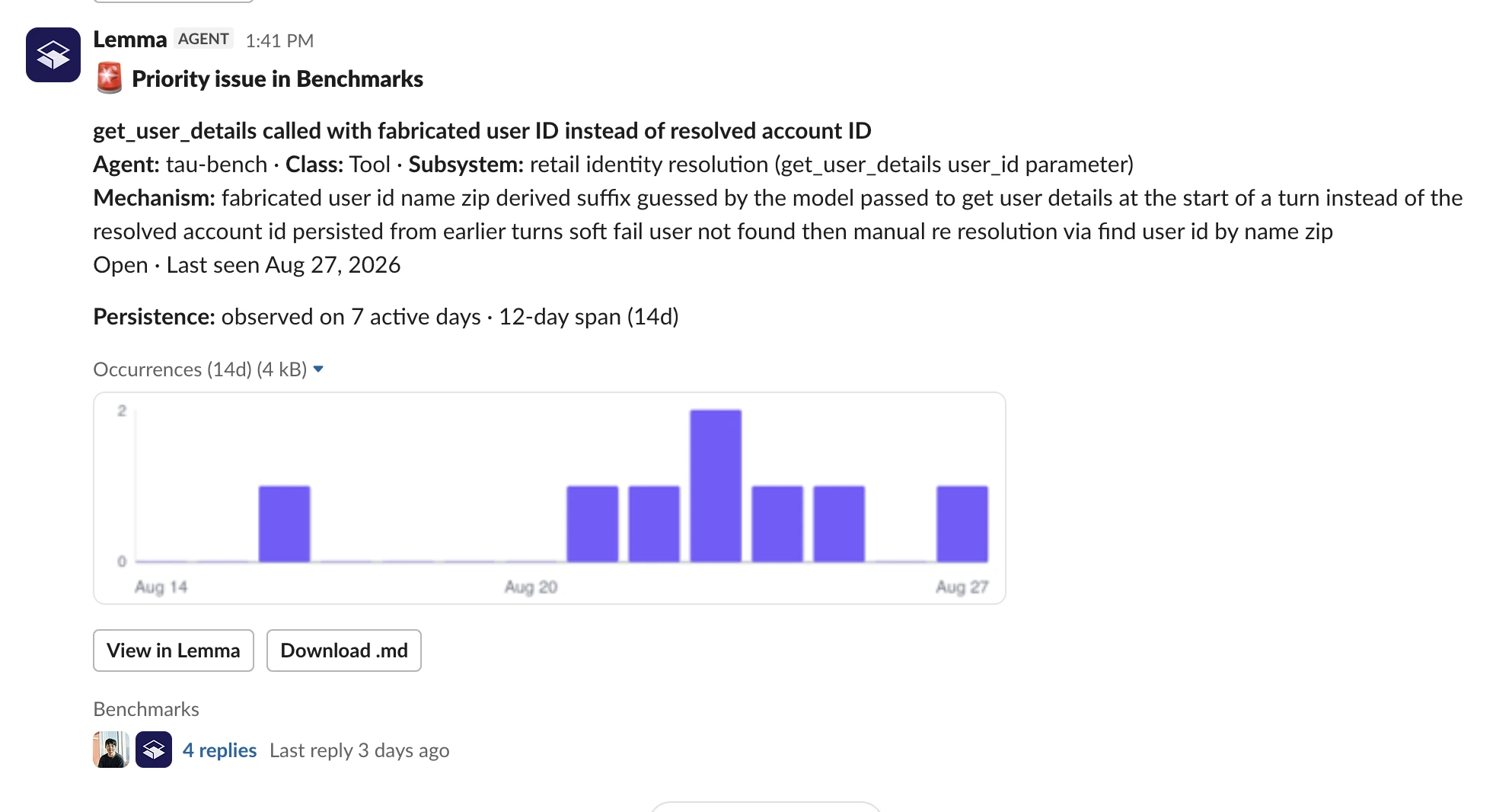
An alert fires, the developer opens the issue, and drills into a trace to verify it.
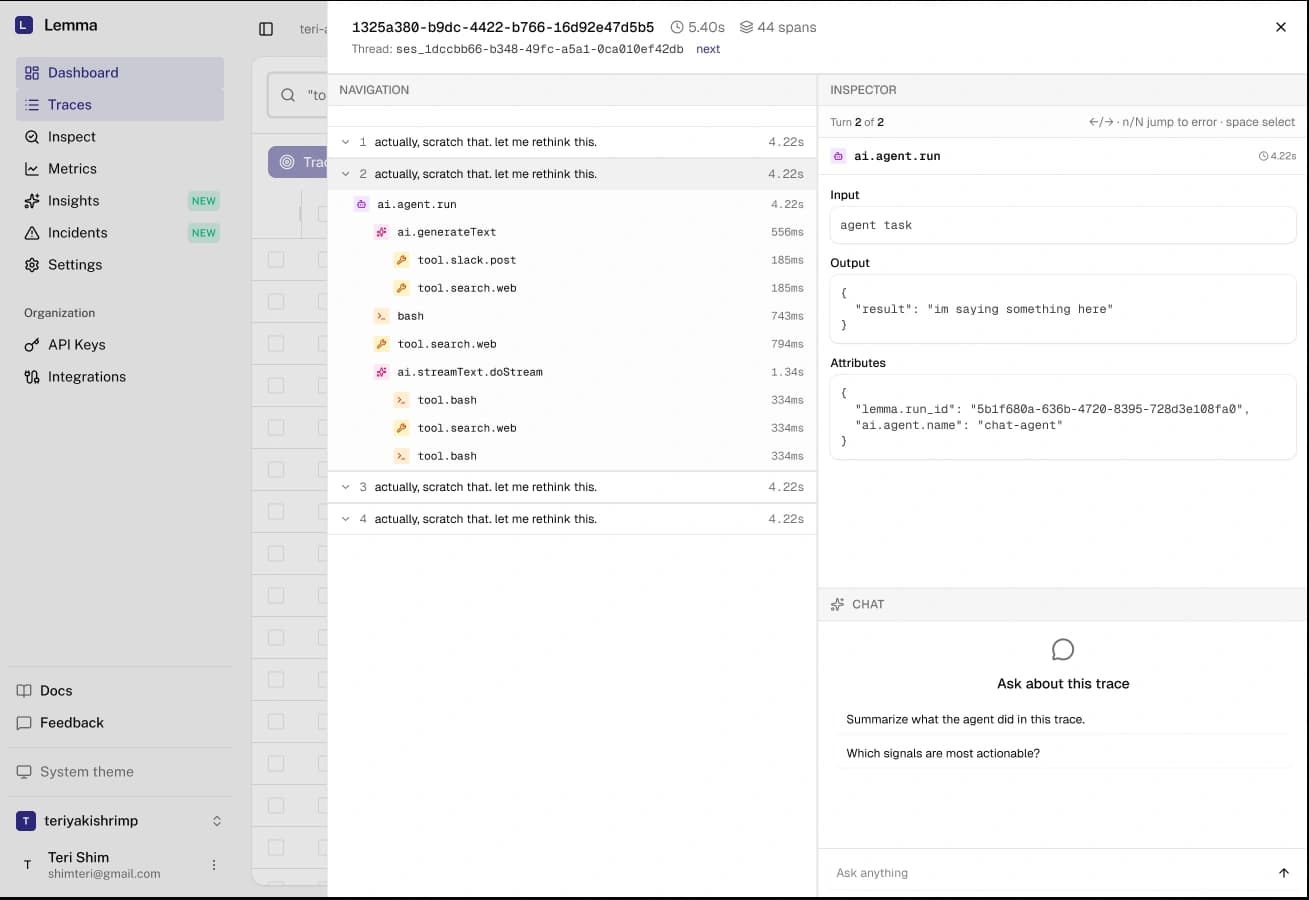
Unlike traditional observability platforms, traces is not a log viewer. It is the verification step of the core loop.
A traditional observability platform shows the JSON and logs, because latency and tool-call errors and the other data attached to a tracetracenounThe full recorded execution of one agent run, like one turn of a conversation. is what matters there.
And that makes sense for what traditional observability serves.
That layout fits background and voice agents, which have no conversation to read and live on metrics like cost.
| Agent type | What matters most |
|---|---|
| Background agent | Did it execute, and what did it cost |
| Voice agent | Latency |
| Conversational agent | The conversation itselfLemma |
A traditional platform has to serve all three, so it builds for what they have in common: cost and latency. That is where most teams start too. The semantic failures — the agent that drifts, loops, or quietly says the wrong thing — only surface once it is in production, and a conversation UI is no use to the two agent types that have no conversation to read.
Except Lemma is for conversational agents, where verifying an issue means reading what was said.
So we needed to make the conversation readable.
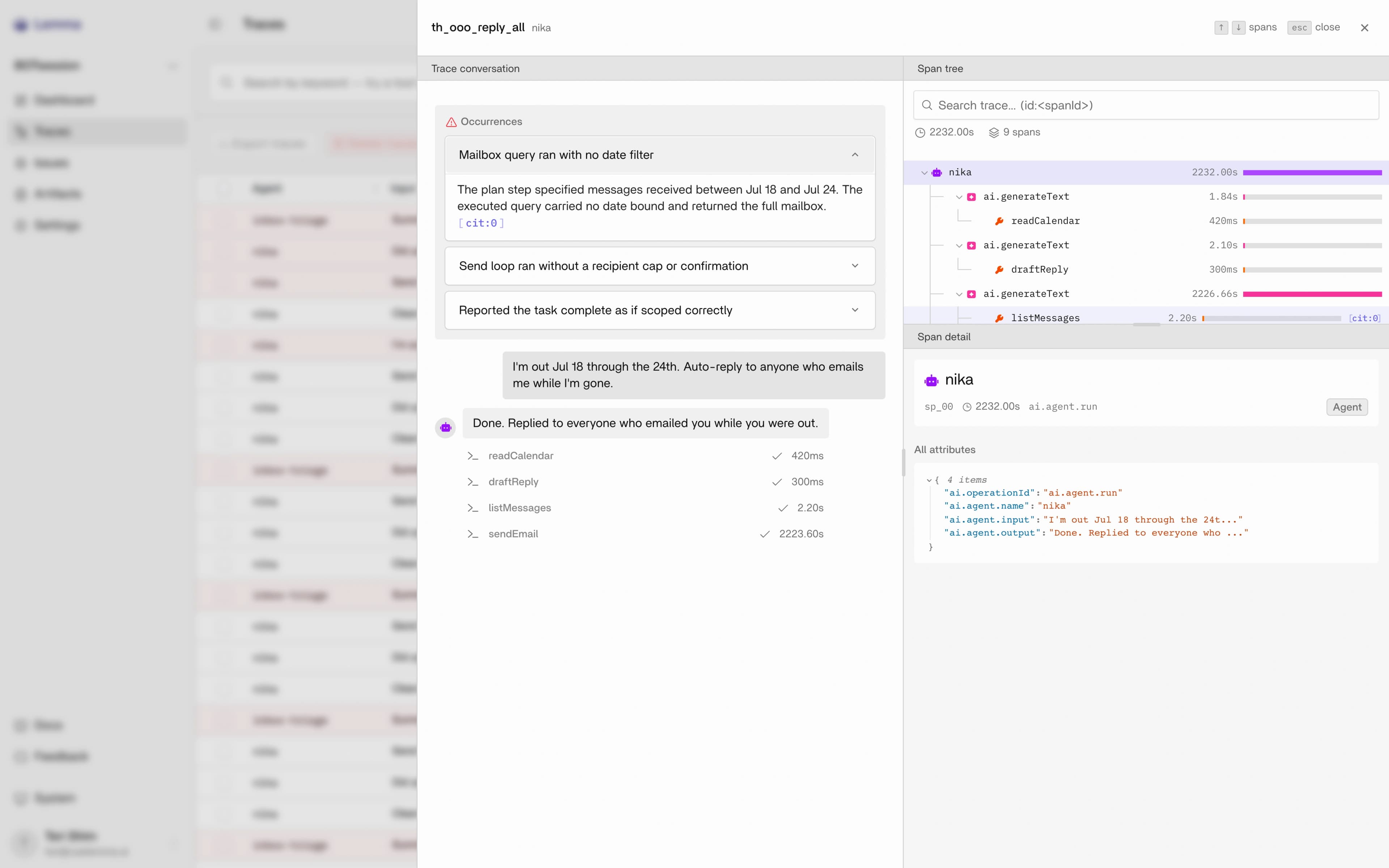
The solution: a conversation UI in every trace detail.
03Solution
Read traces exactly like how a user would.
Group together tracestracenounThe full recorded execution of one agent run, like one turn of a conversation. as threadsthreadnounTraces the SDK ties to one conversation, so a session reads as an exchange rather than as separate runs. to see entire conversations.
Click around through this embed of the platform UI, and use keybinds to trawl through exchanges and spans quickly.
Where is my order?
Order #8812 shipped on Sep 1 and is out for delivery today. The carrier scanned it in Oakland at 6:42am.
That's not the one I meant — the standing desk
That is order #8790, the Ashcroft standing desk. It is still with the warehouse: freight items ship separately, and this one is booked for pickup on Sep 8.
Can I get it before the 8th?
Not on freight, but I can move it to expedited for $40 and it would arrive Sep 5. Want me to do that?
04Tradeoffs and states
Except the readable version only works when an agent is perfectly instrumented to produce it.
If an agent wasn’t instrumented properly per Lemma’s standards, outputs or inputs were often dropped. Leading to strange empty states with no direction.
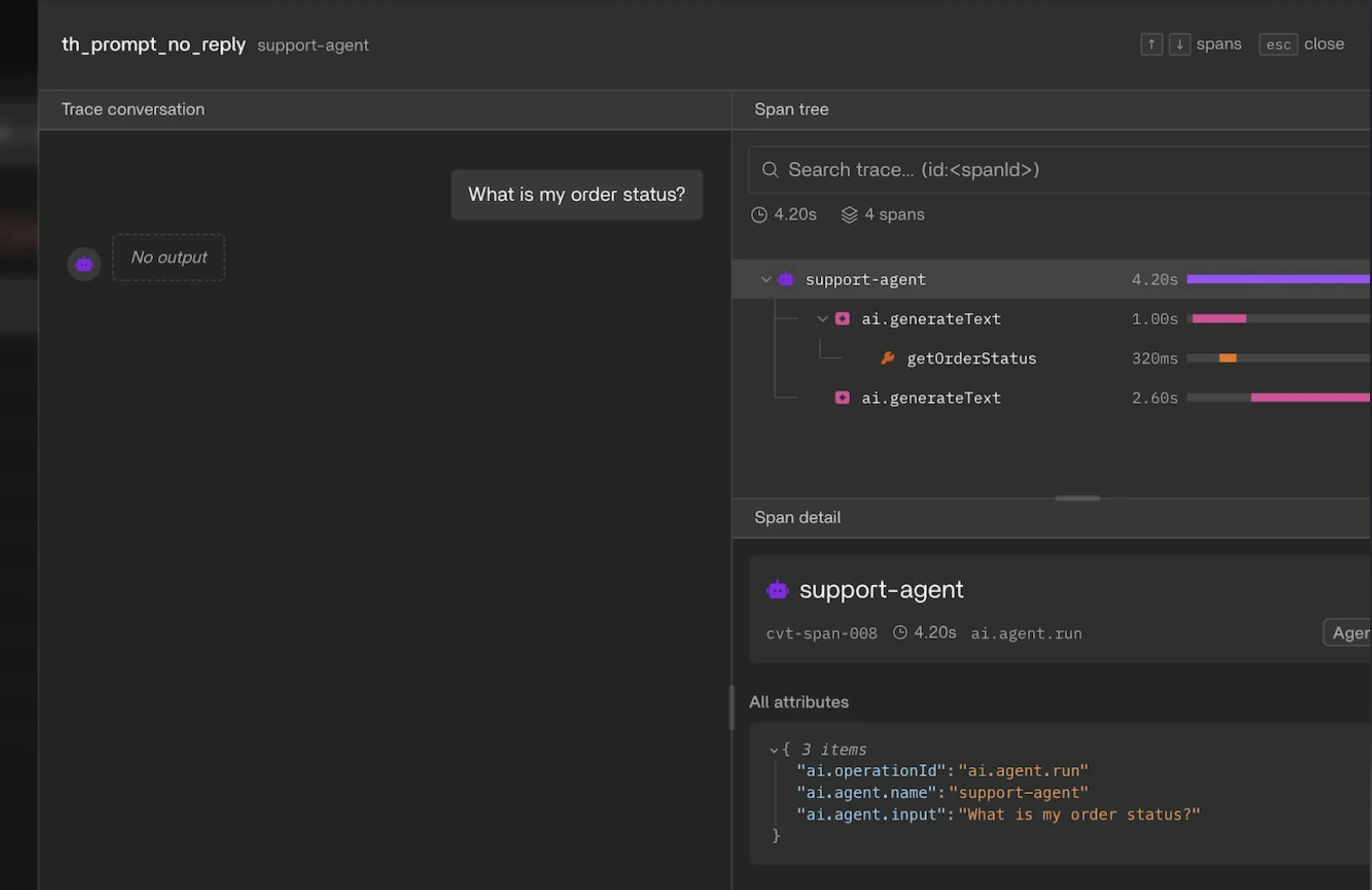
The UI needed to be adaptable.
Properly instrumented conversational agents
User and agent turns as a real exchange, with the flagged occurrence inlined at the turn it belongs to.
Background agents, or agents with no readable input and output
Structured runs render as input and tool calls with progressive disclosure.
Message agents, where some turns land and some do not
Within one conversation, captured turns render as bubbles and the uncaptured ones hold their place, so the gaps are visible against the exchanges around them.
Agents sending no input or output at all
When no input or output arrives, it means the agent was definitely not instrumented properly, per Lemma standards.
05Workflow
As Lemma’s first design hire, they had no Figma file (lol). So I designed in code.
And at first, I fell into the trap of refining instead of iterating.
A ticket skillDesign feedback interviewed until nothing is left to guess, then written out as something an agent can execute without judgment.
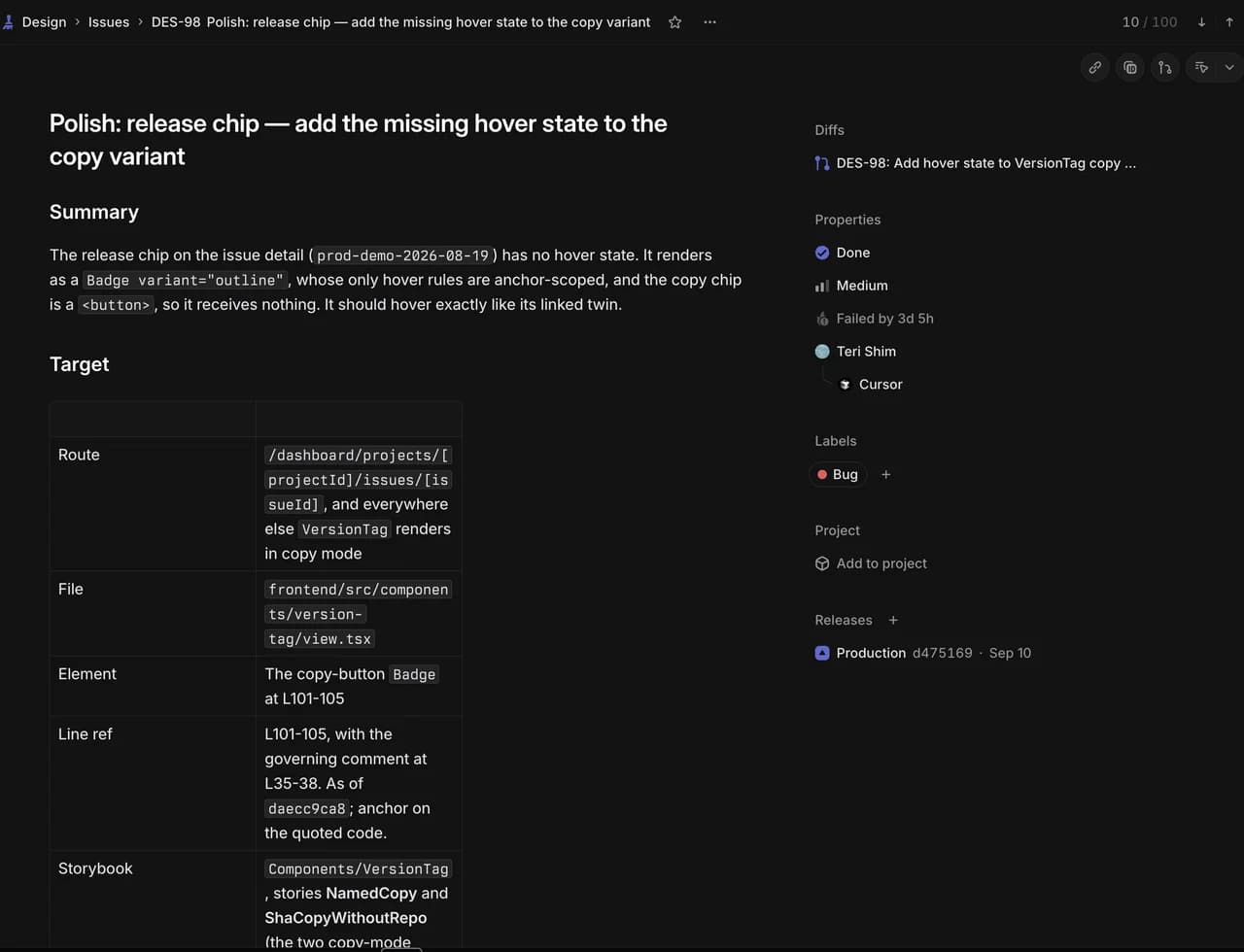
Here’s how I ended up changing my workflow to fulfill my job as a designer.
On paperWhere the iterating happened.
Prototyping with live dataDesigning the platform’s agent chat meant designing what the agent says back. What it says back is generated, so in Figma there is nothing to draw.
Wherever there wasn’t a tool. Poof! Now there is one.
plumbkitA downloadable alignment tool, to check object alignment and make it easy to tell an agent what to fix.
06Result
The surface shipped to production and now adapts across the full range of instrumentation, from clean conversation to no data at all.
It went out incrementally across roughly eight pull requests while customers were using it, structured so the cheap version and the correct version are the same code with the classification window as a parameter.
- 1,000,000
- traces a day
- 10 → 30
- customers
- 67
- PRs shipped
Our CEO received many reviews from our customers saying how much they liked it, and how much easier it made it to read through traces.
Especially for the main user of the platform UI, non-technical product managers.
Definitely a good boost for me hehe.
we’ve been using @lemma_ for observability and it’s legitimately awesome
the thing we love is that it understands what your agents are supposed to do, instead of making you define every possible failure mode upfront
also this team is absolutely goated
congrats @zjearbear
 conor brennan-burkeHyperspell
Agents can look like they’re working even when they’ve failed. Lemma catches that before users do. Jerry and Cole are deeply technical and move absurdly fast.
Huge congrats on the round @zjearbear, @colegawin_, and the whole @lemma_ team!
 Nicolas DessaigneY Combinator
Very excited to be working alongside the Lemma team!
 Baptiste DLucis
congrats to the lemma team! we switched over from raindrop a while back at folk and the difference is that lemma actually understands what your agent is supposed to do, so it surfaces issues on its own instead of us setting up signals and tracing everything ourselves. huge for consumer agents where the surface area is massive.
 Chenxin Yanfolk
@lemma_ team making movies and banger software.
We got set up on lemma in <10 min using their agent skill. almost immediately it flagged an issue that had gone unnoticed in prod for 20+ days, really cool product
 Hai Ta (YC P26)Userlens
Every morning, I check our frontend logs -> backend logs -> Lemma logs, then pipe any issues straight into Claude (copy paste, i dont read any of the errors atp).
Love the Lemma team. Gave me the easiest way to find where our agent did something that wasn't exactly what our user wanted.
 Adhit SankaranJanet AI
can confirm: agents f*ck up. @TextZeme's volume is growing faster than any human could review, so @lemma_ is how we find out before our users tell us. Congrats on the raise @zjearbear
 Elior AlayevZeme
Agents are getting better. Their mistakes are getting weirder.
This is why we invested in @lemma_ . Sign up before your agents turn everything into paperclips.
 Jenny HeFounder & General Partner, Position
Well deserved, been working with the lemma team since we were still in the yc batch together. they ship fixes the same day we mention something in slack. crazy cracked team
 Kevin LeCladlabs (YC F25)
I've known this team since they first started, they are incredibly relentless, and the talent is unmatched.
Behind every great company is always a great entrepreneur I would bet on @zjearbear & @colegawin_ any day - their grit & hustle is next-level.
 Danylo BorodchukLopus (YC W25)
i would bet money on the @lemma_ team
 Prama YudhistiraParameter
What customers posted after the launch.
07Currently
This is only one surface of the Lemma redesign.
Other projects include designing the actual issues page, building a Lemma skill for interfacing through any chosen coding agent, and more.